![B-rdy [be ready!]](https://b-rdy.cz/wp-content/uploads/2025/06/brdylogo_200px_w.png)
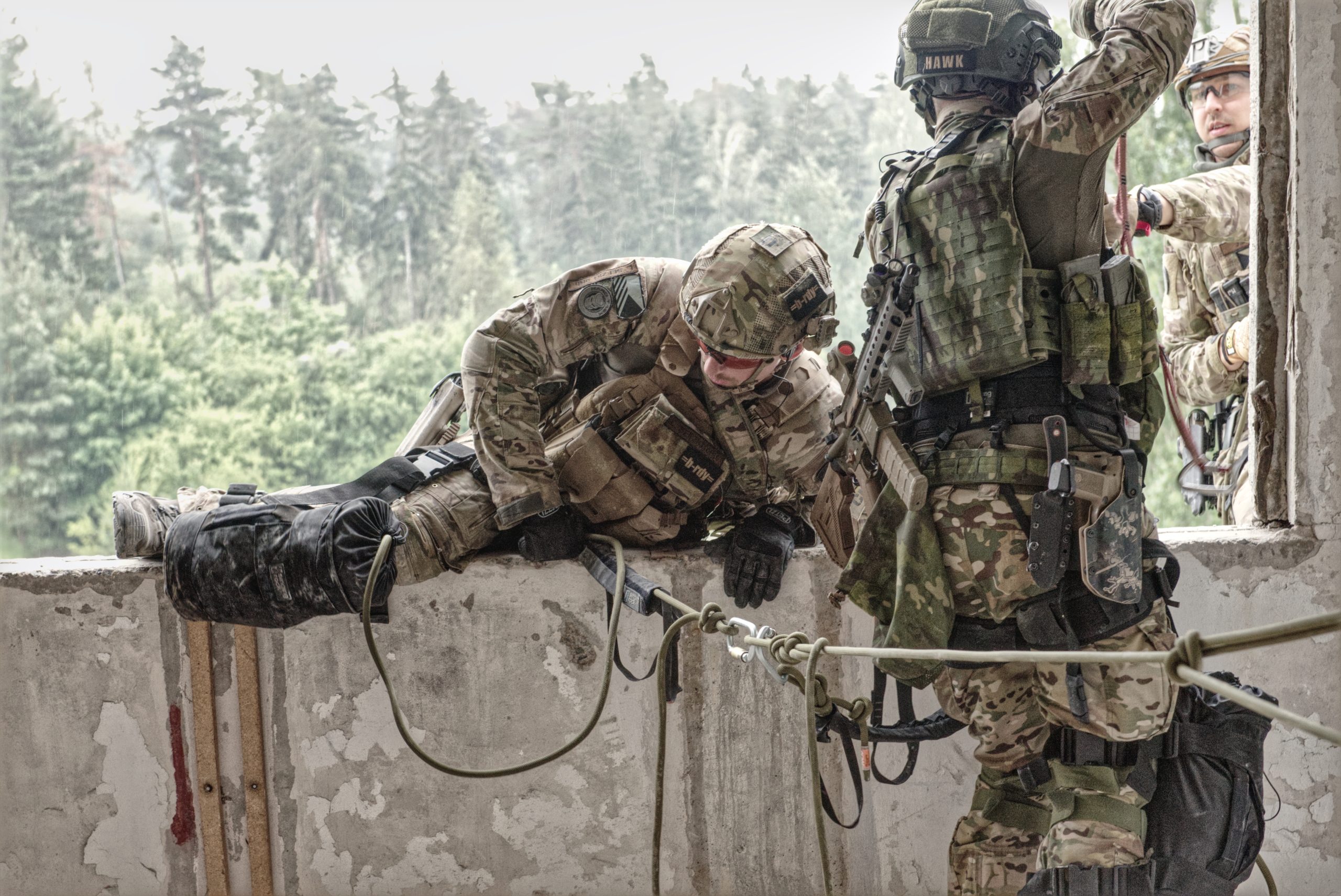
B-rdy Tactical Rappelling Basics is a specialized course focused on safe and effective rope movement in tactical environments. Participants will learn both basic and advanced rappelling techniques from buildings, cliffs, and elevated structures. Emphasis is placed on safety, proper methodology, and applying these skills in real-world scenarios – from urban settings to outdoor terrain.
Beyond basic descent skills we teach robust procedures for equipment checks, anchor building, rope management, team coordination and emergency responses — all adapted for both urban entry and outdoor operations. The course emphasizes repeatable, mission-oriented methods that work under stress.
MAIN BENEFITS
- Master basic and tactical rappelling techniques
- Cooperation with czech company and producer Singing Rock
- Tactical applications: building entry, evacuation, rapid descent
- Realistic scenarios
- Great way to slowly push your limits
This course is for outdoor enthusiasts and civilians seeking realistic rope training in tactical contexts members of armed and security forces professionals in close protection and security services.
GEAR & EQUIPMENT
We can also to borrow you the proper equipment.
Mandatory equipment:
- A full gear equipment including a protection helmet (ballistic or bump or rappelling)
- A gloves for rappelling
- Eyes protection (ballistic glasses)
- A training rifle (airsoft, FX) on a quality sling
- Live ammo + rifle and pistol
- Military shoes
- Knee protection (hard case recommended)
- Gun license ID
Rappelling equipment (we can also rent it for you):
- a certified work harness (f.e. SR Tactic Master)
- 1 HMS carabiner (triple lock)
- 2 aluminum carabiners (triple lock)
- 1 rope min. 30 m (ideally in a rope bag)
- 2 steel carabiners
- a descender brake (Singing Rock JACK or PETZL RIG)
- figure-eight descender or rappel bucket
- 2 rope slings
- sling approx. 1 m for improvising a harness.
- An ascender set is recommended.
LAWS & CONDITIONS
All techniques are taught with strict safety protocols. Rappelling with weapons or for operational purposes should only occur within legal frameworks and authorized missions. The course content is for professional training.
PAYMENT
Registration is mandatory. When you register for a course, you will receive a confirmation email and we will send you an invoice approximately 1 week before the event.
The price will be calculated upon your own equipment.
COURSE & LESSONS DETAIL AND SCHEDULE
Introduction, Safety & Personal Protective Equipment (PPE)
Safety philosophy: Every rope operation begins and ends with safety. We teach layered, redundant checks and standardized callouts so that safety becomes automatic even under pressure.
- Helmet – full helmet use for impact protection during urban/rock operations.
- Eye protection – goggles or ballistic safety glasses for debris and flash.
- Footwear – sturdy boots with ankle support and grippy soles for varied terrain and ledges.
- Gloves – abrasion-resistant gloves for rope handling (and specific thin gloves for weapons manipulation when needed).
- Knee/elbow protection – pads for contact during entry/egress or steep descents.
Procedural safety elements:
- Double-check / Triple-check / Dual inspection — layers of verification: individual gear check, partner check (doublecheck), and instructor/lead check (triple/dual) prior to committing to the rope.
- Command & control (callout technique) We practice concise, repeatable phrasing to avoid confusion. “I climb — I belay”
- Equipment inspection & rigging checks
- Overview: systematic pre-operation inspection and documented revision of all gear.
- Rope inspection: sheath integrity, soft spots, age/usage tracking.
- Hardware checks: carabiner gates (tri-locks and locking), belay devices, slings etc.
- Triplelock / Dual checks explained
- Load management: how to distribute loads and identify single-points-of-failure.
Anchors & Stand (building the stand)
- Anchor capacity – how to evaluate anchor points (structural vs. natural), rated loads and safe working loads.
- Fall factor – what fall factor means for force on system and how to minimize it in tactical descents.
- Force distribution / load sharing – using multi-point anchors and equalization to reduce risk from any single anchor failure.
- Stand construction – practical step-by-step building of a multi-point stand (slinging, equalizing, backup, directional anchor considerations).
Knots — what and why
- Figure-eight (Figure-8) +. Threaded figure-eight (Figure-8 follow-through / tied-in)
- Stop-knot
- Alpine butterfly
- Bypass for multiple people — techniques to allow multiple users on a single line safely.
Rappelling techniques & starts
- Rappel with a mechanical belay (rig) + entry positions:
- From kneeling (combat-style low profile start) — lower signature and faster transition under cover.
- From standing (controlled start)
- Wall / face rappelling — continuous descent along structure.
- Free-space rappelling (exposed drop) — rope management and body positioning when there is no wall contact.
- Urban-specific starts (taught on day two): window exits, balcony drops, parapet transitions and controlled descents through apertures.
- 8 figure rappelling — technique, pros/cons, when to use figure-8 vs. modern devices.
Improvised rappels
- HMS
- Improvised seat harness
- Lowering & rope retrieval techniques
- Methods for retrieving ropes after descent and tactical rope recovery
- Rappelling by anchoring on person — controlled lowering using a human anchor in emergency scenarios (strict safety rules).
Ascending the rope (ascending techniques)
- mechanical ascenders, laddering techniques.
- Practical drills: self-rescue, re-ascending after passing a knot, and casualty extraction up a line.
Rope management skills
- Rope change / rope swap — safe procedures to transition between ropes in the middle of an operation.
- Passing a knot on rappel — techniques to ascend or manage knot transitions without compromising safety.
- Rope coiling, stowage and rope-bag discipline — tactical bagging to reduce snagging and speed transitions.
Casualty handling & rescue
- Rescue of an unconscious / incapacitated person on rope — hauling, lowering, body support, and stretcher considerations.
- Self-rescue procedures — when a single operator must extract themselves or a partner.
- Winch/haul systems for multi-operator recovery.
Shooting on the rope
- Safety & legal considerations — weapons control while on rope, muzzle discipline, and rules of engagement.
- Shooting positions and stabilization — fundamentals for minimal movement and trigger control while suspended.
- Weapon retention & transition drills — safe manipulation of weapon during descent and immediate action if required.
(Emphasis: firearms on rope only in controlled, authorized environments and under strict SOPs.)
Combined model exercise (urban + outdoor elements), debrief & after-action review.
Team procedures & coordination
- Rope bag discipline — how to rig and deploy rope bags for fast, snag-free exits.
- Entry coordination — synchronized entry in pairs or teams (roles: entry, cover, safety), timing and communication.
- “50/50” procedure — simultaneous entry / shared responsibility drills for split teams: half entry / half cover transitions to maintain continuous tactical security.
- Signals & non-verbal cues — quiet communication options for stealth or noisy environments.
DOWNLOAD MATERIALS
Go to Trainings page and download the printable targets and other materials for your training.
BASIC INFORMATIONS
| Tier | 1 – individual skills |
| Recomm. competence | Novice with gunlicese |
| Course length | 2 days (16 hours) |
| Graduation | Certificate |
| Graduation requirements | passing final exam |
| Course capacity | Class with 10 students |
| Language | Czech | English |
| Ranges | TBA |
| Price | CZK 5500 (incl. VAT) |
COURSE GRADUATE PROFILE
A graduate of the B-rdy Tactical Rappelling Course will be capable of safely and confidently operating with ropes in both urban and outdoor tactical environments. He or she will understand and apply all fundamental safety principles, including the correct use of protective equipment, systematic double and triple checks, and standardized rope commands. The graduate will know how to inspect and maintain ropes and hardware, evaluate anchor points, calculate fall factors, distribute loads, and construct reliable multi-point stands. Through the course, the participant will gain practical mastery of essential knots such as the figure-eight, alpine butterfly, stop-knot, and their emergency variations, and will be able to choose and apply them under stress. The graduate will be proficient in controlled rappelling with devices such as the rig and figure-eight, will be able to perform improvised rappels. He or she will be experienced in tactical applications, including rappelling from windows, balconies and parapets, managing rope bags, and coordinating entries in pairs or small teams according to tactical procedures. The graduate will also be capable of ascending ropes, passing knots, changing lines, and handling rope management under demanding conditions. The result is a professional-level capability to use rope techniques in a systematic, safe, and tactically effective way.
REFERENCES FROM OUR STUDENTS
-
References will be added soon…
GALLERY
VIDEOS & INSPIRATION – TBA